Inside this article
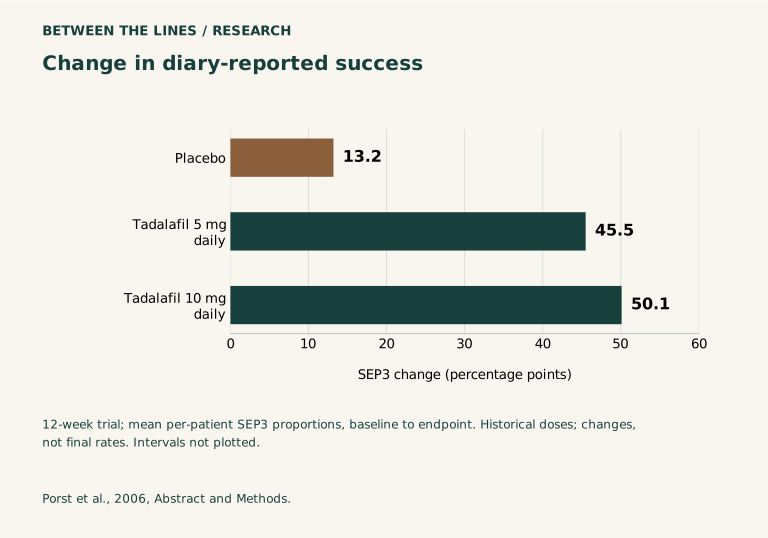
A result can be mathematically correct and still be read as the wrong kind of answer. A change may be mistaken for a final level; an average across people may be confused with a tally across events. This essay follows those transitions slowly enough to inspect them. The accompanying chart holds the reported estimates. The discussion uses original, explicitly invented arithmetic to explain how a diary result can acquire meaning without becoming a forecast for an individual reader.
Porst’s blinded trial randomized men with ED to daily oral tadalafil or placebo. SEP3 concerned successful intercourse completion. The useful next step is to examine how an answer travels through a calculation: first it belongs to an occasion, then to a person’s record, then to a group summary. Those stages should stay visible when the finding enters a conversation. The examples below are teaching constructions, not reconstructed trial records or previously unreported findings.
Trial chart and data
Download chart (PNG) · Download data (CSV) · Download vector (SVG)
| Group | Change |
|---|---|
| Placebo | 13.2 |
| Tadalafil 5 mg daily | 45.5 |
| Tadalafil 10 mg daily | 50.1 |
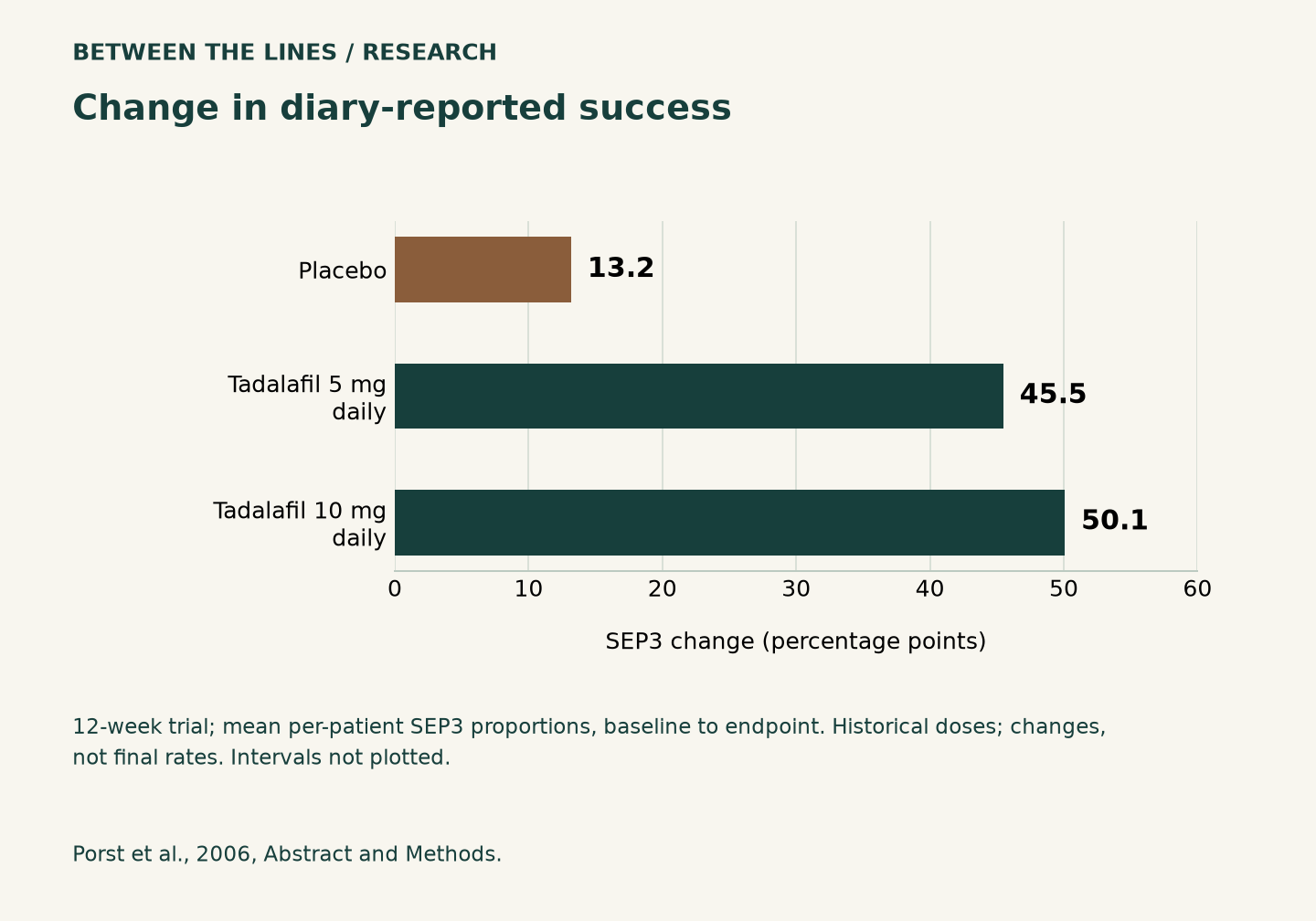
12-week trial; mean per-patient SEP3 proportions, baseline to endpoint.
Historical doses; changes, not final rates. Intervals not plotted.
The question comes before the calculation
A yes-or-no response is useful only after the question has been defined. The answer records whether a stated condition was met; it does not expand to include every neighboring concern. For example, a question about an event’s completion is not automatically a question about satisfaction with the entire experience. That distinction is logical, not a judgment that one concern matters more. A scientific reading begins by respecting what the measurement asks and identifying the additional questions a reader still has.
It can help to rewrite the measurement in a short sentence without its acronym. Then write the question that motivated the search for evidence. If the sentences differ, the result may still be relevant, but the connection needs explanation. The journal’s guide to what an assessment can clarify offers a broader setting for that discussion. Research can inform a clinical question without exhausting it. The first task is to connect the two sentences carefully, rather than letting a familiar outcome word stand in for an entire treatment experience.
Build the person’s proportion before the group summary
Suppose one invented diary contains one positive answer in two recorded encounters, while another contains eight in ten. Their personal proportions are 50% and 80%. An equally weighted average is 65%. Pooling all recorded encounters instead gives nine positives in twelve, or 75%. The second calculation gives more influence to the diary containing more encounters. This example does not identify an error; it identifies two estimands, meaning two quantities a calculation is designed to describe. The arithmetic becomes easier to discuss once the intended quantity is named.
The table makes those operations explicit. Equal weighting at the person level does not mean that every underlying diary has equal length or equal precision. Pooling events does not make the resulting number a proportion of people. The choice must follow the scientific question and the documented analysis. A reader who notices the order of operations can ask a more useful question than simply whether the percentage is large. Keep this invented example separate from the paper’s reported estimates; its role is to explain weighting, not to supply missing participant records.
| Calculation | Illustrative result | Quantity described |
|---|---|---|
| Person A: 1 / 2; person B: 8 / 10 | 50% and 80% | Each person’s proportion of positive answers. |
| Equal-person average | (50% + 80%)/2 = 65% | The average of two personal proportions. |
| All encounters pooled | 9 / 12 = 75% | The proportion among all twelve recorded encounters. |
Ask whether the same people occupy both ends
A change calculation refers to a beginning and an ending. Before interpreting it, ask whether the same people contribute to both summaries and what rules define those contributions. In an invented two-person example, baseline proportions of 20% and 60% become 50% and 70%. The individual changes are 30 and 10 percentage points, averaging 20. The baseline average is 40% and the later average 60%, also a difference of 20 points. That agreement follows from using the same people with the same weights at each stage.
It does not license subtracting arbitrary averages from different sets of records. If one person is absent from a later summary, the group composition has changed as well as the time. That observation does not dictate a particular statistical remedy; it identifies information that must be examined. A readable report should make the analysis population and handling of incomplete observations traceable. The companion discussion of what a sildenafil attempt count leaves unsaid approaches a related unit problem. Separate studies should retain their own definitions rather than being forced onto one numerical scale.
Percentage points need a different sentence from percentages
Consider an invented proportion rising from 25% to 40%. Its absolute change is 15 percentage points. Its relative increase is 60%, calculated by dividing the 15-point change by the starting 25%. These descriptions use the same two numbers but emphasize different relationships. Neither description means that the final proportion is 15% or 60%. A reader can prevent much confusion by writing the starting value, ending value, subtraction and division on separate lines before deciding which statement a headline makes.
Starting points also constrain what changes are possible. A proportion near the top of its scale has less room for an upward change than one near the bottom. The table illustrates this arithmetic without assigning any of its invented values to trial participants. A relative increase from a zero baseline is undefined under the usual division rule, even though an absolute percentage-point change can be calculated. These features belong to the scale itself. They should not be interpreted as biological explanations or evidence that a treatment works differently in a particular subgroup.
| Starting and ending proportions | Absolute change | Relative calculation |
|---|---|---|
| 25% to 40% | 15 percentage points | 15 / 25 = 60% increase. |
| 50% to 65% | 15 percentage points | 15 / 50 = 30% increase. |
| 0% to 15% | 15 percentage points | Division by the zero starting value is undefined. |
Give incomplete diaries their own analysis question
A blank diary record is not explained by an unrelated measurement rule. A method used to handle a missing questionnaire score should not be carried into a diary calculation unless the paper explicitly describes that use. Different instruments may have different schedules, eligibility rules and units. The reader’s task is to locate the procedure associated with the endpoint being discussed, then distinguish what is documented from what remains unknown. Similar-looking columns do not establish that the same statistical operation was applied to them.
An original way to inspect the issue is to imagine a ledger with three separate headings: observation expected, observation obtained, and rule used when absent. A missing response becomes visible without being silently turned into either a positive or a negative answer. This ledger is a reasoning aid, not a reconstruction of the study. It also makes a useful distinction between describing missing information and testing sensitivity to it. An analyst could explore alternative assumptions, but a reader must not claim that such an analysis occurred unless the report actually documents it.
A score and a diary proportion have separate meanings
A questionnaire score can summarize several responses using a specified scoring system. A diary proportion summarizes responses relative to a set of recorded occasions. Similar direction of change does not create a universal conversion between them. A point on one scale is not automatically a percentage point on another. To translate results, a reader would need a justified relationship between the instruments, not merely two numbers appearing in adjacent columns or sharing a word such as improvement.
An invented analogy is a restaurant rating beside the proportion of orders delivered correctly. Both concern the same service experience, but a change in the rating cannot be divided into a change in delivery accuracy. The analogy describes measurement logic rather than equating healthcare with a purchase. A clinical outcome deserves its own definition and interpretation. Before combining results, ask which features of experience each measure captures, how its scale is constructed, and what additional evidence supports the proposed link. Keeping the coordinates separate often reveals a more precise question than trying to collapse everything into one success figure.
Read the comparison as well as the change
A change within a group asks what differs between two observations over time. A comparison between groups asks an additional question about the contrast between their results. The two operations are related but not interchangeable. In a hypothetical study, both groups could improve while differing in the size of that improvement. Conversely, a change that sounds substantial in isolation might look different when placed beside the comparison group. The interpretation depends on the actual design and estimate, not on whether the word improved appears in a sentence.
A comparison group can help place shared study circumstances and the passage of time into the question being investigated. It cannot remove every uncertainty merely by existing. Precision, missing observations, participant selection and measurement choices still deserve attention. A bar’s height describes a reported estimate; its visual separation from another bar is not a substitute for an uncertainty calculation. When intervals are not displayed, do not invent them. Nor should similar-looking estimates be described as proof of equivalence, which would require a specifically justified question and analysis.
Choose a question that can survive the summary
A group summary is designed to compress information. The practical challenge is to decide which personal question remains relevant after that compression. A reader may be interested in consistency across occasions, the ability to describe a response clearly, or whether an unwanted effect needs discussion. These are possible questions, not additional outcomes attributed to the study. A useful appointment note can identify the concern first and then record which part of the research helps frame it. The evidence should sharpen the note rather than replace its purpose.
The articles on making room for an ED conversation and revisiting a treatment discussion provide context for that next step. An original exercise is to distinguish an observation from an interpretation: describe what happened, then state what you think it might mean, keeping the two statements separate. That structure gives a clinician room to evaluate the interpretation. It also prevents a published average from becoming an expectation that an individual must meet or a verdict about someone whose experience differs.
Research arithmetic does not replace the current label
Current Cialis labeling for daily ED treatment begins at 2.5 mg and permits an increase to 5 mg according to efficacy and tolerability. The chart’s higher daily research regimen lies outside routine daily ED labeling. Labeled contraindications include nitrate use and guanylate cyclase stimulators, including riociguat. Kidney and liver function, cardiovascular health, accompanying alpha-blockers or antihypertensives, strong CYP3A4 inhibitors and substantial alcohol exposure need clinician assessment. Recognized adverse reactions include headache, indigestion, back pain and muscle aches. An erection lasting longer than four hours needs emergency care. Sudden vision loss, or an abrupt reduction or loss of hearing, calls for stopping treatment and promptly obtaining medical attention. Chest pain, dizziness or nausea during sexual activity calls for stopping the activity and getting immediate medical help. Do not combine PDE5 treatments or adjust doses independently.
These instructions serve a different purpose from the diary calculation. Reading a historical research schedule is not selecting a personal regimen. A percentage-point difference cannot establish suitability, and a clearer explanation of an average does not remove the need to discuss an actual prescription and health history. Keep label questions identifiable when preparing for that conversation. The statistical interpretation and the clinical assessment can inform one another while remaining different tasks; neither should disappear inside a single favorable number.
Check the product before attaching a result to it
According to FDA, compounded preparations are not FDA-approved and do not undergo its premarket assessment of safety, effectiveness and quality, although they can meet legitimate medical needs. Product identity therefore remains a separate part of evaluating a claim. Ingredients, formulation, route and combination matter to the question of what evidence applies. The journal’s article on taking a closer look at treatment claims helps organize that examination without assuming that familiar wording establishes equivalence.
Service information has another job. The Hims reading note and Ro reading note offer places to inspect recorded commercial details; these links do not assign trial outcomes to either provider. As an editorial exercise, keep three questions on separate lines: what is the product, what does the research measure, and what does the purchase agreement say? A missing answer in one line cannot be supplied by a persuasive answer in another. This arrangement makes uncertainty actionable as a question to resolve, rather than encouraging an unsupported ranking based on a mixture of clinical and commercial claims.
Questions about the evidence
Is a change in a proportion the proportion at the end?
No. A change describes the difference between a starting and ending value. Recovering a final value requires a compatible starting value and the relevant calculation. Do not substitute rounded values from another population or endpoint.
Why can averaging people differ from pooling their encounters?
A person-level average gives each included personal proportion a stated weight. Pooling encounters gives influence according to the number of recorded events. The resulting quantities can differ even when both are calculated correctly from the same invented records.
Can a diary result be converted into questionnaire-score points?
A conversion requires an established relationship between the measurement systems. Sharing a clinical topic is insufficient. Identify what each instrument measures and what its numerical unit represents before attempting to translate one result into the other.
Does a missing-data method apply to every outcome in a paper?
Only if the report supports that scope. Locate the method attached to the endpoint under discussion. Similar terminology or neighboring tables does not establish that a diary and a questionnaire received identical treatment when observations were absent.
What should a reader do with an unclear treatment claim?
Ask for the precise outcome, population, product and source behind it. Separating those elements can reveal whether the uncertainty concerns the study, the product identity or the interpretation. A numerical headline alone cannot resolve all three.
Editorial assessment
An average becomes more useful when its construction remains visible. Follow the answer from an occasion to a person’s proportion, identify how personal records enter the group summary, and distinguish that summary from a change over time. Then ask whether the result addresses the question that matters in the next conversation. This process does not require pretending that every uncertainty can be solved from a publication. It requires naming what is known, what operation produced the number, and what additional information would be needed for a different conclusion. That is a more durable reading skill than memorizing a favorable percentage.
Research access and limitations
Complete retained paper reviewed; direct access restricted. No protocol or participant-data review. All worked arithmetic is illustrative rather than observed trial data. This essay neither evaluates providers nor predicts a personal response.
The sources behind this page
Scientific references carry their individual access dates below. Existing medical and provider records retain their original October 6 or 7 checks. Provider pages describe advertised products and terms; they do not independently establish treatment quality.
- Porst et al. (2006): daily tadalafil trialRetained primary paper; recheck restricted · Checked 2026-10-23Exhibit PDF (recheck restricted)
- Goldstein et al. (1998): oral sildenafil trialRetained primary paper; recheck restricted · Checked 2026-10-23Exhibit PDF (recheck restricted)
- Cialis (tadalafil) prescribing informationOfficial prescribing information; relevant sections reviewed · Checked 2026-10-23
- Understanding the risks of compounded drugsFDA public guidance · Checked 2026-10-23