Inside this article
A percentage becomes easier to discuss when its noun stays attached. A person, an attempt and a questionnaire response are different things to count. Changing that noun changes the question, even when the printed number looks familiar. This essay follows the route from an observation to an interpretation, then considers what a reader might reasonably bring into a clinical conversation. The chart supplies the empirical result; the reasoning below examines the machinery around a measurement.
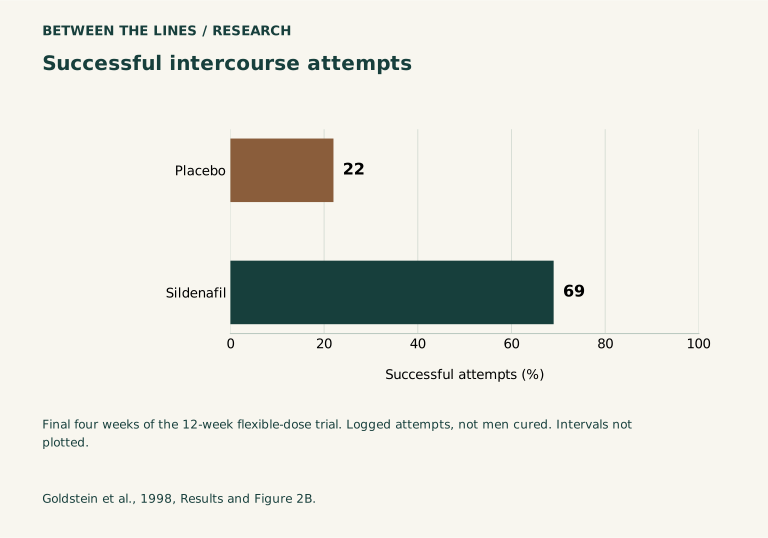
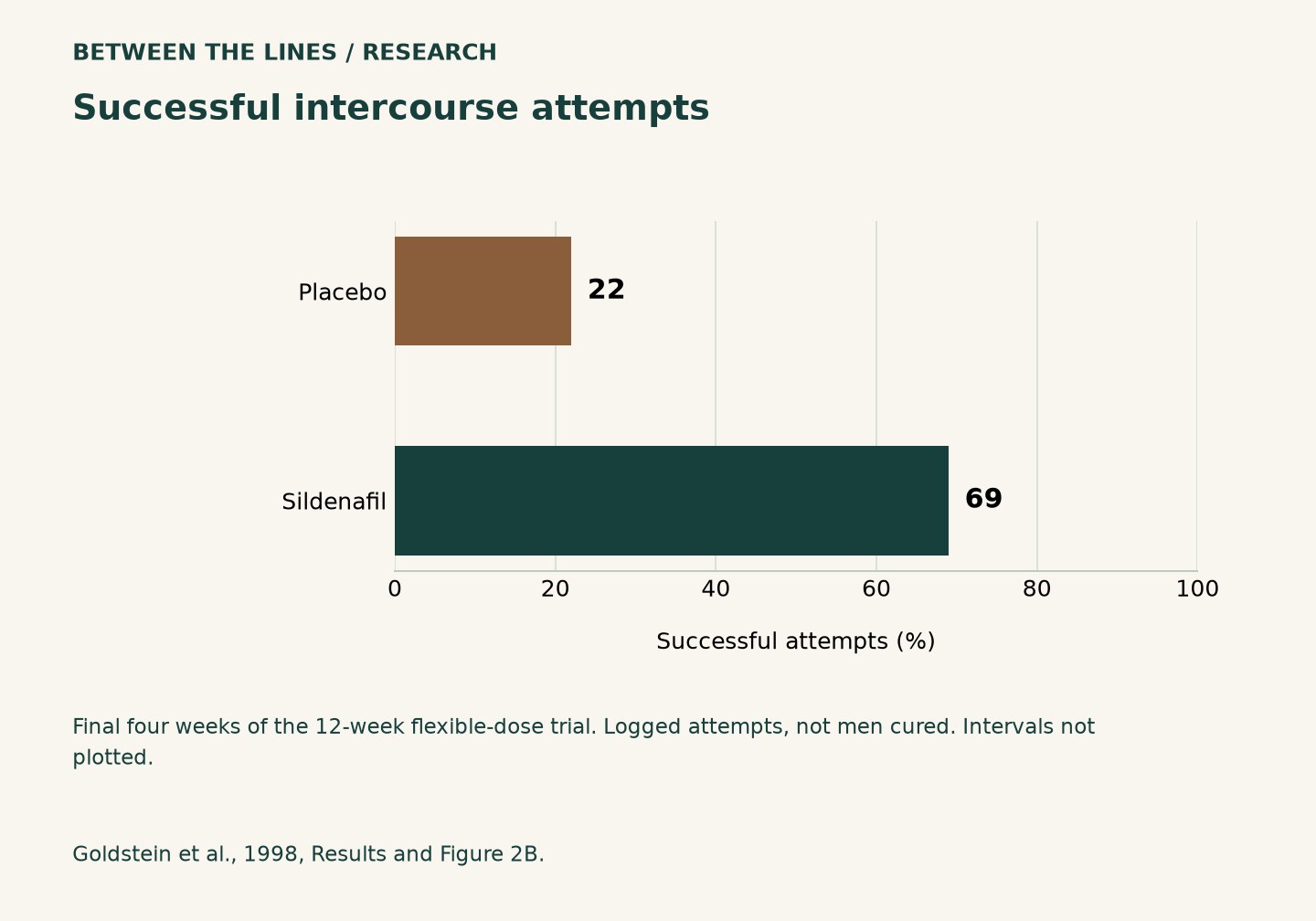
Goldstein’s randomized, blinded studies compared oral sildenafil with placebo in men with ED; questionnaires and event logs provided different measures. That brief anchor opens a larger question: what must be known before a recorded event can say something useful about someone’s experience? Every numerical example in the discussion is invented for explanation, not reconstructed participant data. The purpose is to make the logic inspectable without pretending that a short research summary contains every diary or every personal concern.
Trial chart and data
Download chart (PNG) · Download data (CSV) · Download vector (SVG)
| Group | Reported value |
|---|---|
| Placebo | 22 |
| Sildenafil | 69 |
Final four weeks of the 12-week flexible-dose trial.
Logged attempts, not men cured. Intervals not plotted.
Start with the noun underneath the percentage
Imagine receiving a result written simply as a fraction. Before asking whether it is encouraging, ask what one mark on each side represents. If the denominator contains events, the numerator must describe events selected by a stated rule. If it contains people, the corresponding numerator concerns people. A useful reading habit is to complete the sentence in ordinary language before looking at the size of the fraction. The exercise can reveal an unsupported jump that a polished headline makes easy to miss.
This is a problem of measurement before it becomes a problem of judgment. A counted event can establish that the recording rule was met on that occasion. It does not automatically describe satisfaction, confidence, unwanted effects, or the meaning of an experience to a particular person. Those are additional questions with their own observations. Our guide to what an ED assessment can address places research reading beside the broader task of describing a concern. A precise scientific answer is valuable partly because it makes its remaining questions easier to name.
One person can contribute many entries
Consider two invented diaries. One contains one successful event in one attempt; the other contains one success in nine attempts. Combining their entries gives two successes in ten attempts, or 20%. Giving each diary equal weight instead gives the average of 100% and about 11.1%, or about 55.6%. Both calculations follow a coherent rule. They answer different questions because the second diary supplies most of the events but remains only one of the two people. The table keeps each operation visible rather than allowing a familiar percentage sign to conceal the weighting choice.
This arithmetic is a teaching example, not a reconstruction of the published diaries or a claim about an unreported analysis. Its lesson is to ask which observations receive weight. An event-weighted description and an equally person-weighted description can diverge without either number being a transcription error. Neither tells us the full distribution of experiences. Before treating a group result as a personal forecast, a reader would need substantially more than the group percentage, including information that the chosen summary deliberately compresses.
| Record or calculation | Arithmetic | Interpretation |
|---|---|---|
| Diary A | 1 success / 1 attempt = 100% | One person supplied one recorded attempt. |
| Diary B | 1 success / 9 attempts ≈ 11.1% | One person supplied nine recorded attempts. |
| Two summaries | 2/10 = 20%; (100% + 11.1%)/2 ≈ 55.6% | Pooling events and equally weighting people answer different questions. |
Random assignment does not answer every measurement question
Random assignment gives a comparison a starting structure: treatment allocation is determined by the study procedure rather than chosen because of an expected response. That structure does not make every later measurement self-explanatory. A reader still needs to identify the observation being compared, when it was recorded, and which records entered the calculation. The scientific work of defining an outcome remains necessary even when the allocation process is strong. A clear design label should begin the examination, not substitute for it.
It also helps to keep two ideas separate: the assigned group and the amount of information later contributed. A hypothetical participant could supply many entries, few entries or an incomplete record while retaining the same original assignment. Those possibilities raise different questions about follow-up and analysis. They do not, by themselves, prove that randomization failed or that an effect disappeared. When another paper chooses a different numerical summary, examine that choice independently. The companion essay on the diary behind a tadalafil average develops that reading task without turning separate trials into a medicine ranking.
A blank space is not a failed attempt
An empty diary cell can tempt a reader to fill it with a convenient assumption. Yet an unrecorded observation and a recorded negative answer are not interchangeable pieces of information. A day without an attempt also differs from an attempted event whose result was not entered. The distinction matters because a calculation can change when a blank becomes part of its denominator or is assigned an outcome. The first task is therefore descriptive: establish what the recording system means by an entry, an absence and an excluded record.
The following table is an original reading aid, not a list of situations observed in this trial. It shows why the same visual blank can demand different follow-up questions. A defensible explanation should identify the rule used and the information that supports it. If that information is unavailable, describe the uncertainty rather than selecting a favorable assumption. Missingness cannot be repaired merely by changing a word in the headline. Nor should the reader infer a particular correction method simply because another endpoint in the same paper uses one.
| What is known | What remains unknown | Question for the analysis |
|---|---|---|
| A negative answer was recorded | Why that particular event differed | Does the stated outcome rule include this observation? |
| No attempt was recorded | Whether the diary was complete | Is an opportunity absent, or is information absent? |
| An entry is missing | The event and its outcome | What documented rule addresses this gap? |
The calendar can change the question
A diary is more informative when its observation window remains attached. A summary over an early interval and one over a later interval need not describe the same stage of experience. Even a complete set of entries cannot make unequal windows interchangeable. The question is not simply whether one period contains more events. It is whether the periods were defined in a way that makes the intended comparison intelligible. Calendar boundaries are part of an outcome’s meaning, not decorative details placed beside the result.
For an invented example, suppose a diary contains six entries in one interval and two in another. Comparing the raw number of successful entries would combine any difference in results with the difference in opportunities. Calculating a proportion addresses one part of that problem, but it still does not explain why opportunities changed. A reader should resist silently supplying a cause. These are useful questions to organize before opening a conversation about erection difficulties: which experience is being described, over what period, and what information would help distinguish an observation from an explanation?
A questionnaire is another view of experience
A questionnaire turns an answer into a coded response. A diary organizes observations around events. Neither description makes one instrument universally more useful; the intended question determines what a reader needs. A recalled judgment may summarize an experience across occasions, while an event record keeps occasions separate. When the two are discussed together, the important step is to identify what information each representation retains and what it compresses. Agreement can be informative, but differences deserve examination rather than automatic dismissal.
An original analogy is a reading journal alongside an end-of-month book rating. The entries and the rating concern related experience, yet adding entries does not calculate the rating, and dividing a rating does not recover the entries. Clinical measures require their own definitions, but the logical distinction is similar. Avoid translating a score change into a success percentage without an established conversion. Likewise, a response category should not acquire a physical ratio interpretation merely because it has a number attached. First inspect the measurement rule; only then ask whether a proposed comparison is justified.
More events do not create more independent people
Repeated observations offer detail about a person’s experience, but the word repeated should remain visible in the interpretation. Events contributed by the same person share that person and may share circumstances. Treating the number of entries as though it were the number of independently recruited people would erase the structure of the information. This is a question to ask of an analysis, not a claim that the historical paper made that error. A reader should look for an explicit explanation before judging how uncertainty was handled.
Consider two invented collections containing the same number of entries: a few people each contribute many, or many people each contribute a few. The total alone cannot tell us which collection gives a more precise answer to every possible question. That depends on the question and on relationships within the data. A chart without uncertainty intervals leaves those intervals unshown; it does not establish that uncertainty is absent. Do not manufacture bounds from the visual length of a bar or calculate a person-level number needed to treat from an event-level contrast.
Translate the result into a question, not a prediction
A useful clinical conversation can begin by identifying what the research measured and then naming what still matters personally. A reader might want to discuss reliability across occasions, unwanted effects, or difficulty describing a response. These are possible conversation topics, not claims that the trial measured every one of them. The link between a research endpoint and a personal priority should be explained rather than assumed. A narrow measurement can still contribute useful information when its role is kept proportionate.
One practical exercise is to write two short sentences: one describes the outcome under discussion, and the other describes the unresolved question. If they use different nouns, explore the difference before deciding that the evidence has settled the issue. Our article about returning to a treatment conversation provides a place to organize that next discussion. A group estimate does not determine an individual response, and an individual experience does not rewrite the study. Keeping both statements true allows research and clinical assessment to inform each other without confusing their responsibilities.
Keep current safety information beside the arithmetic
Viagra’s current prescribing information lists indigestion, headache and flushing among its recognized adverse reactions. Nitrates or nitrites and guanylate cyclase stimulators, including riociguat, are contraindicated. Cardiovascular health, kidney or liver function, other medicines, alpha-blockers and antihypertensives need clinical assessment. Do not independently combine ED treatments or change a regimen. An erection persisting beyond four hours requires immediate medical assistance. For sudden vision loss or a sudden decrease or loss of hearing, stop the medicine and seek prompt care. Stop sexual activity and obtain immediate help for chest pain, dizziness or nausea during sex.
These instructions belong to a different reading task from interpreting an efficacy chart. A tidy arithmetic explanation cannot decide whether a medicine is appropriate for a particular person. Nor can a study summary replace the details a clinician or pharmacist needs to assess an actual prescription and health history. Keeping safety information in its own clearly identified paragraph makes it easier to find without suggesting that an average response balances an urgent symptom. Questions about a treatment’s suitability should remain questions for the treating team, even when the research result itself has been understood.
Carry the measurement boundary into product research
FDA states that compounded drugs do not receive its approval or premarket evaluation of safety, effectiveness and quality; compounding can nevertheless address legitimate medical needs. This leaves a separate evidence question whenever a product’s formulation, combination or route differs from the product studied. Our guide to reading treatment claims more closely helps identify what a commercial description actually specifies. Naming an ingredient does not, on its own, establish that every preparation containing it inherits the same research result.
A useful documentary comparison has distinct spaces for product identity, purchase terms and clinical evidence. The Hims provider note and Ro provider note can be used to inspect the publication’s recorded service information, without treating a link as a trial-based endorsement. This is an editorial method for organizing questions, not evidence of a provider’s outcomes. If a claim depends on a study, trace the claimed outcome back to its unit and population. If a term concerns an order or renewal, identify the relevant commercial record. The exercise is successful when an unresolved question becomes clearer, even if no ranking follows.
Questions about the evidence
Can an event percentage tell me how many people benefited?
Not without additional information connecting events with people and defining benefit. One person may contribute several events. An event-based fraction therefore cannot simply be relabeled as a proportion of people, even when the numerical value would make an appealing headline.
Why can two averages describe the same invented diaries differently?
Their weighting rules differ. Pooling entries gives more influence to diaries containing more events; averaging person-specific proportions gives each included person equal weight. State the question and the rule before deciding which calculation is relevant.
Does a missing entry count as a negative result?
Its meaning depends on the documented recording and analysis rules. An absent observation, an absent opportunity and a recorded negative response are different states. Assigning them the same numerical value requires justification, not convenience.
Should a questionnaire and a diary produce identical answers?
Only an explicit relationship between their measurement rules could support that expectation. Related experiences can be summarized in different ways. Examine what each measure represents before interpreting disagreement as a contradiction or converting one result into another.
What is a useful question to take into an appointment?
Describe the experience you want help understanding, then identify which part of that experience the research outcome addresses. That separation can make the remaining clinical question more specific without presenting a published group estimate as a personal prediction.
Editorial assessment
The strongest reading of an event result keeps its unit visible through every step of the discussion. First identify what was observed, then inspect how observations became a summary, and finally ask how that summary relates to the question at hand. This sequence gives uncertainty a useful place: it marks information still needed rather than making the entire result meaningless. Research can sharpen a conversation without deciding it in advance. A reader who can distinguish an attempt, a person and a questionnaire response is better equipped to ask a precise question about a treatment claim.
Research access and limitations
Retained complete exhibit reviewed; direct access restricted. No protocol or participant-level data reviewed. Worked examples are original illustrations, not trial observations. The analysis does not evaluate a provider or predict individual outcomes.
The sources behind this page
Scientific references carry their individual access dates below. Existing medical and provider records retain their original October 6 or 7 checks. Provider pages describe advertised products and terms; they do not independently establish treatment quality.
- Goldstein et al. (1998): oral sildenafil trialRetained primary paper; recheck restricted · Checked 2026-10-23Exhibit PDF (recheck restricted)
- Porst et al. (2006): daily tadalafil trialRetained primary paper; recheck restricted · Checked 2026-10-23Exhibit PDF (recheck restricted)
- VIAGRA (sildenafil citrate) US prescribing informationOfficial prescribing information; relevant sections reviewed · Checked 2026-10-23
- Understanding the risks of compounded drugsFDA public guidance · Checked 2026-10-23